
2013

2014

2015

2016


2020
(cancelled)

2022


2025

(cancelled)
|
eLivermore.com - By Bill Nale |
|
Bill's Baseball Basics |
|
2013 |
2014 |
2015 |
2016 |
|
2020 |
2022 |
|
|
2025 |
|
||
|
2021 (cancelled) |
|
Photo Site |
Contents:
Common Misconceptions in Baseball
Foul Lines and Fair Balls diagram
Home Plate diagram
Double First Base basics
Common Misconceptions in Baseball
This is a list of common misconceptions in
baseball.
Most of the people at the LLIWS know most of these, but there are some esoteric
and controversial ones.
In reading social media comments, many people harbor baseball myths and are
quite sure that they are facts
So here is a list of ones that I see often.
Everything here is my opinion.
Consider it unofficial.
The Little League Rule Book is where to look for the official wording.
I'm not even an umpire! I'm a photographer. But I have documented
thousands of plays. And researched them.
All references to sections of the Little League Rule Book are for the 2026 version. Reference numbers do not normally change from year to year, however.
| Myth | Explanation | |
|
First Base |
||
|
1.1 |
You must turn to your right after overrunning First Base or you can be tagged out. |
This is not a rule,
and never has been. You can turn either way, but if you make a motion
towards 2nd base (after turning right or left), you are in jeopardy of being
tagged out. Looking to 2nd is not enough, but one step with intent can
be. It is an umpire's judgment. Generally it is very obvious
when it happens. Many people think that the rule states that you must always
turn to the right, because they were always taught that. The reason
that they were taught that is because it is MUCH simpler for a coach to tell
the players, especially the younger ones, to always turn to the right.
That helps prevent them from making a move toward 2nd, or even seeing the
opportunity to do so. They want younger players to listen to the first
base coach when it comes to possibly going to second base. |
|
Batter's Box |
||
| 2.1 |
Any portion of your foot out of the batter's box when you hit the ball causes you to be out. |
Your ENTIRE foot must
be touching the ground and be completely outside of the batter's box (no
portion touching the batter's box line) for you to be called out. You
must also hit the ball. Fair or foul does not matter. A foot
that is not touching the ground is not considered outside of the batter's
box. |
| 2.2 |
If your foot is touching the plate when you hit the ball you are out. |
The plate has nothing
to do with it. The batters box is only 4 or 6 inches (depending on
division) from the batter's box, so it is certainly possible for the foot to
be touching the plate at the same time it is also touching the batter's box
line. The only determining factor is whether either foot is on the
ground and entirely out of the batter's box. |
| 2.3 |
The feet must be entirely within the batter's box when the pitch is thrown. You can't crowd the plate. |
This is a tough one.
6.03 states: The batter's legal position shall be with both feet
within the batter's box. An "Approved Ruling" (right after the
previous text) says: A.R. - The lines defining the box are
within the batter's box. To be considered out of the batter's box
when hitting the ball a foot must be on the ground and COMPLETELY outside of
the batter's box, not touching the lines. Presumably the same
definition applies to before the pitch is thrown. But I have seen
umpires at the Little League World Series (Williamsport) require the entire
foot to be on or inside of the line and moving a player back. |
| 2.4 |
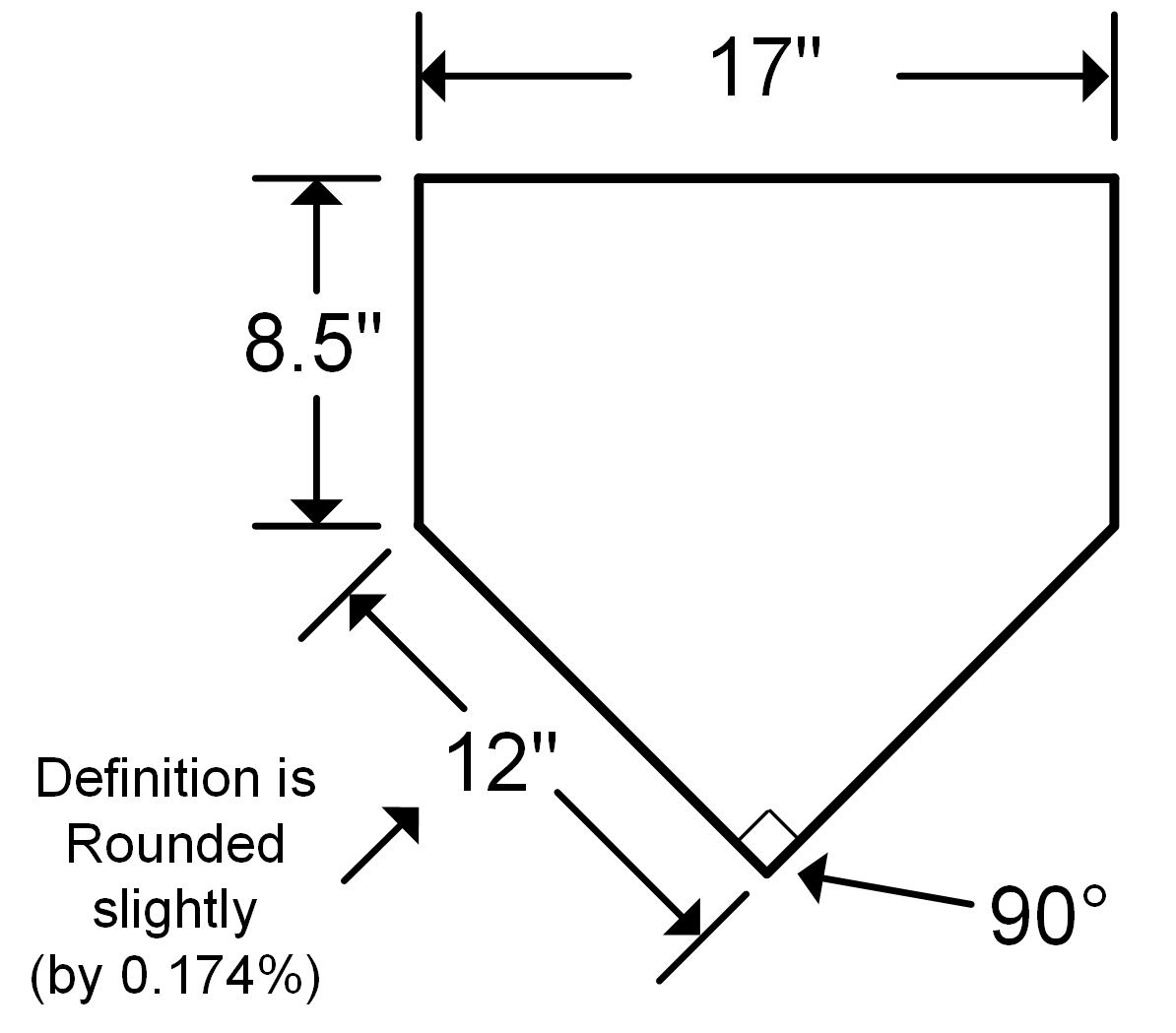
The tip of home plate is not a right angle. |
It IS a right angle. The myth was apparently started by Mr. Spock (who knew that they played baseball on Vulcan). The theory goes something like this: If you take the published dimensions for home plate: (17 inches wide, 8.5 inches along each side, and 12 inches from the sides to the back tip) and you do the math, the angle of the back tip is almost, but not quite 90 degrees. Reality: it should be considered to be 90 degrees, and that the dimensions are very slightly rounded to the listed amounts. Frankly, it is amazing that dimensions that only go down to the inch (the 8.5" number is irrelevant) are able to get as close as it does. It would look a bit silly to list the angled portion of the base as being 12.02082", now wouldn't it!!! Excel formula: =sqrt(17^2/2) The 17 inch width is the primary dimension. The 12 inches portion is a derived dimension, so it is the rounded one. Imagine asking a manufacturer to make a base where one of the dimensions is 12.02082". They would charge $100,000 due to the implied accuracy requirement. Some extrapolate that the first and third base lines are also not at right angles because of the home plate rounding error. If you read the instructions on how to lay out a field, you will find that the base lines are in fact at right angles. Those instructions are in the Little League Rule book, by the way. |
| 2.5 |
When viewed from the air with a base line at the bottom, the 4 bases form a perfect square. |
Second base is actually out of
place. On a 90 foot field, it is 90 feet from the back tip of home
plate to the far side of the 1st and 3rd bases. However, it is 90 feet
from foul line at the back corner of first or third base to the MIDDLE of
second base (see diagram below). So the
base is offset toward center field. This can generally not be noticed
as 10.61" (15" base) is not much compared to 60, 70, or 90 feet between
bases. |
|
Hit by Pitch |
||
| 3.1 |
If you are hit by pitch while swinging, you still go to first base. |
The ball is dead and
a strike is called. If the 3rd strike, the batter is out.
Runners may not advance. |
| 3.2 |
If you are hit by pitch that would have been called a strike, you still go to first base. |
The ball is dead and
a strike is called. If the 3rd strike, the batter is out.
Runners may not advance. |
| 3.2 |
If you are hit by the pitch after making no attempt to get out of the way, you still go to first base. |
The ball is dead.
Umpire calls a ball or strike based on the position of the ball. It is
the umpire's judgment as to whether the batter made a legitimate attempt to
get out of the way. |
| 3.4 |
The hands are part of the bat. |
The hands are NOT
part of the bat. A pitch hitting the batter's hands, even if they are
around the bat, is a hit by pitch, assuming the other requirements (not a
strike, etc) are met. |
| 3.5 |
If the batter is hit by the pitch which bounced off of the ground before hitting them, they do not go to first base |
They ARE awarded first base,
assuming they made a reasonable attempt to get out of the way and did not
swing. |
|
Home Runs |
||
| 4.1 |
A ball that hits a fielder's glove when in fair territory, then goes over the fence without hitting the ground is a ground rule double. |
It is a home run if
the ball goes over the fence in fair territory.
Famous case in MLB. In 1993 a ball bounces off of Jose Canseco's head
and goes over the fence. It was a home run. |
| 4.2 |
A ball that bounces off the top of the fence and is caught by an outfielder is an out. |
It is not an out.
It is a live ball and is in play. |
| 4.3 |
On a home run over the fence, you don't have to run / touch the bases. |
You must run the
bases, and touch each base. If you do not, it is an appeal play.
The appeal would take place after the ball is put back in play by the
umpire. If it was a walkoff home run, the defensive team must inform
the umpire that they will appeal the play before he/she leaves the field.
Timing can be tricky here. |
|
Fair and Foul Balls |
||
| 5.1 |
Once a batted ball touches foul territory, it is a foul ball. |
If the ball hits or
goes into foul territory, then bounces or rolls into fair territory before
1st or 3rd base, then is
touched by a fielder, it is a fair ball. |
| 5.2 |
The plate is in foul territory. |
The entire plate, as
well as all bases are entirely in fair territory. The only exception
is the orange portion of the double first base, which is entirely in foul
territory. |
| 5.3 |
The foul line is in foul territory. |
The entire width of
the foul line is in FAIR territory. 100% of the ball must be on the
outside of the foul line to be a foul ball. Any portion being over the
any portion of the foul line (at the time that fair/foul is determined)
makes it a fair ball. See diagram
below. |
| 5.4 |
The foul pole is in foul territory. |
The entire foul pole is in FAIR territory. If the ball even just touches or goes over the outside edge of the foul pole, it is fair. Any horizontal extensions of the pole (like a corrugated screen) are put on the fair side of the pole. |
| 5.5 |
A fielder touching a ball while standing in foul territory makes the ball foul |
It is the position of
ball, NOT the feet of the fielder that determines fair of foul. |
| 5.6 |
If one umpire signals a foul ball while another signals a fair ball, it is the umpire who officially has that call that will take precedence. |
Any umpire calling a
foul ball, or calling Time kills the play. Even if it is done
incorrectly. It is often stated that "You can't un-ring a bell". |
|
Appeals |
||
|
6.1 |
An appeal play can be done at any time. |
The ball must be live
for the appeal to be made. On a home run over the fence, or if time as
been called, the appeal must be done after the ball is put back in play, but
before any pitch or play is attempted. The "Play attempted" can get
tricky. |
| 6.2 |
On a sacrifice fly, if a different runner left early and is out on appeal which results in the 3rd out, the run does not count because it is a force out. |
It is not considered
a force out. It is considered a "time" play (I hate that term.
Should be a "timing" play, but I digress). If the run scored before
the
other runner is out on appeal, the run counts. If the runner that scored also left early, the defense must appeal that runner to prevent the run from scoring, even if there were already 3 outs. This is the famous "Apparent 4th out" case. That last out "replaces" one of the previous outs. I did see this occur once in a local Little League game. |
| 6.3 |
Nothing more can happen after the 3rd out. |
Appeal plays can
happen, which could nullify a run. This might result in the "Apparent
4th out". |
| 6.4 |
With a double first base, upon returning to the base after overrunning, the batter-runner must not touch the orange base at all or they can be tagged. |
After the
batter-runner overruns first base, consider that the orange base has
magically disappeared. Touching it or stepping on it is the same a
stepping on dirt. It does not constitute returning to first base.
That does not happen until they touch the white base. Sooo... There is an often
replayed video of a LLSB Regional in which it appears that a player is
called out for returning to the orange base, or possibly staying on that
base for too long (although she was physically blocked from returning to the
white bag by the first baseman). All sorts of theories were thrown out
on social media. In reality, she was called out because she missed the orange
base when overrunning it initially, and tagged when returning. The
umpire initially called her safe, as he should. The first baseman was
alerted by a teammate to the possibility of her missing the orange portion,
then blocked the white portion with possession of the ball (legally) and
tagged her. The umpire called her out on the appeal. All of that
returning to the wrong base or staying too long was a red herring. |
| 6.5 |
On a sacrifice fly, the runner cannot leave the base until the ball is caught. |
The runner can leave
the base as soon as any fielder touches the ball. The vast majority of
the time the first touch is also the catch. |
| 6.6 |
Either the defense or the offense can request the plate umpire to ask the base umpire whether the batter swung or not. |
Only the defense is permitted to request this. If the plate umpire calls a strike, there can be no appeal to base umpires. |
| 6.7 |
When the plate umpire asks the base umpire whether the batter swung, he is asking for his opinion on the matter. |
The plate umpire is actually GIVING the call to the base umpire. The base umpire then makes the call.. This link has an explanation. That link also lists that in Little League the plate umpire is not required to ask the base umpire if the defense requests it. |
|
Walkoff Situations |
||
| 7.1 |
In the bottom of the last (or extra) inning, on a base hit that scores the winning run, any run that successfully scores on the play counts. |
Once the winning run
scores additional runs that come across the plate do not count. If a
hit, the batter should be given credit for the single if the runner from 3rd
scored the winning run, double if the runner from 2nd scored the winning
run, etc. This would be subject to change if errors were involved. Note that all of this
is true for all "walk-off" situations, including 10 run rules, and generally
in lower divisions where there is a run limit within innings. |
| 7.2 |
If there is a hit or fly ball which scores the winning run (walk-off situation) but this run will be appealed (runner left early on sac fly, missed 3rd base, etc), nothing more can happen during the play such as another run legally scoring (which becomes the winning run if the earlier one is out on appeal), or defense tagging additional (possibility celebrating) runners out such that after the appeal and the game continues, those outs count. |
There is no known
answer to this question. Nothing in the rule book covers it.
Asking this question in a room full of umpires will cause a fist fight to
break out!! One umpire stated
that after the winning run comes across the plate the game is over and
nothing else can happen (He would, however, be required to entertain the
appeal).
My opinion of what should be done: |
|
Obstruction / Interference |
||
| 8.1 |
It is not obstruction if the fielder is pulled into the path of the base runner to attempt to catch the throw. |
In Little League, it is still
obstruction. In some other organizations it is not. |
| 8.2 |
There must be contact for obstruction to be called |
No contact is necessary.
Obstruction is defined as "Obstruction is the act of a fielder who, while
not in possession of the ball, impedes the progress of any runner. A
fake tag is considered obstruction" |
| 8.3 |
There must be contact for interference to be called. |
No contact is necessary.
Offensive Interference is defined as: "an act by a member of the team at
bat which interferes with, obstructs, impedes, hinders, or confuses any
fielder attempting to make a play". |
| 8.4 |
If the base runner is hit by a batted ball they are always out. |
In MOST real world cases, they
will be called out. |
| 8.5 |
The plate is the only base that a fielder can block. |
Any base can be blocked by a fielder who has possession of the ball. No base (including the plate) can be blocked by a fielder who does NOT have possession on the ball. |
|
Other |
||
| 9.1 |
If you run more than 3 feet outside of a line directly between bases you are out for being out of the baseline. |
As a famous umpire
once said: "The runner can go the outfield fence if he/she wants if there
is no play being made on him/her". Being out of the baseline only
occurs if there is a play being made on the runner. When that tag
attempt begins, the "base line" becomes a straight line from the current
location of the base runner to the next base, or to the previous base if
he/she attempts to return to it. At that point they can not go outside
of the imaginary line by 3 feet. In the umpire's judgment it is often
considered to be "a step and a reach" for the fielder. |
| 9.2 |
In Majors and below, the runner may not do a head first slide at any time. |
In Majors and below,
a head first slide is
not permitted when advancing to a base, but is allowed with going back to a
base. |
| 9.3 |
It is a catch if the fielder holds the ball for 3 seconds |
How long the ball is
held does not determine whether the catch is completed. The fielder
must show voluntary release of the ball. I.E. attempting to take the
ball out of their glove. An umpire may also consider the fielder
regaining their balance / momentum after catching the ball as finishing the
catch. |
| 9.4 |
The ball is dead on a foul tip, no runners may steal or be thrown out. |
A "foul tip" is when
the ball comes off the bat sharply and immediately is caught by the catcher.
A foul tip can occur with any count on the batter. The ball is live. |
| 9.5 |
On a bunt attempt, if the batter does pull the bat back, it is a strike. |
The batter does not
have to pull back the bat. If the pitch is not in the strike zone, it
will only be called a strike if the batter offers at it. I.E. moves
the bat towards it. If the batter holds the bat over the plate, and
does not move it, it is not counted as "swinging". This is a judgment
call by the plate umpire. |
| 9.6 |
Tie goes to the runner |
One of my least favorite rules.
Ambiguity abounds. In the end it does not matter. The umpire
calls what they call. |
| 9.7 |
If the base dislodges when a base runner makes contact, they must remain in contact with either the base itself, or the area where the base was. |
This is an unusual situation,
but I have seen it happen. |
| 9.8 |
Why do teams change pitchers during a half inning for no apparent reason, sometimes after the first batter of an inning? Why didn't they change pitchers at the start of the half inning instead, saving time. |
This generally happens when a pitcher reaches a specific pitching threshold, and facing another batter would cause them to require an additional days rest. It does occur after the first batter at times. The manager wants to keep the pitcher in as long as possible before reaching the pitching threshold. When the pitcher reaches their maximum pitches in a day, they MUST be removed at that point. This process does slow down the game at times, but it is an important strategy. |
There are many other lists of Baseball myths on the web. One is here. Note that that one was written before 50/70 was part of Little League, so where it says "Juniors and above", that includes 50/70. Junior 80s predated 50/70, and used 80 foot bases for 13 year olds.
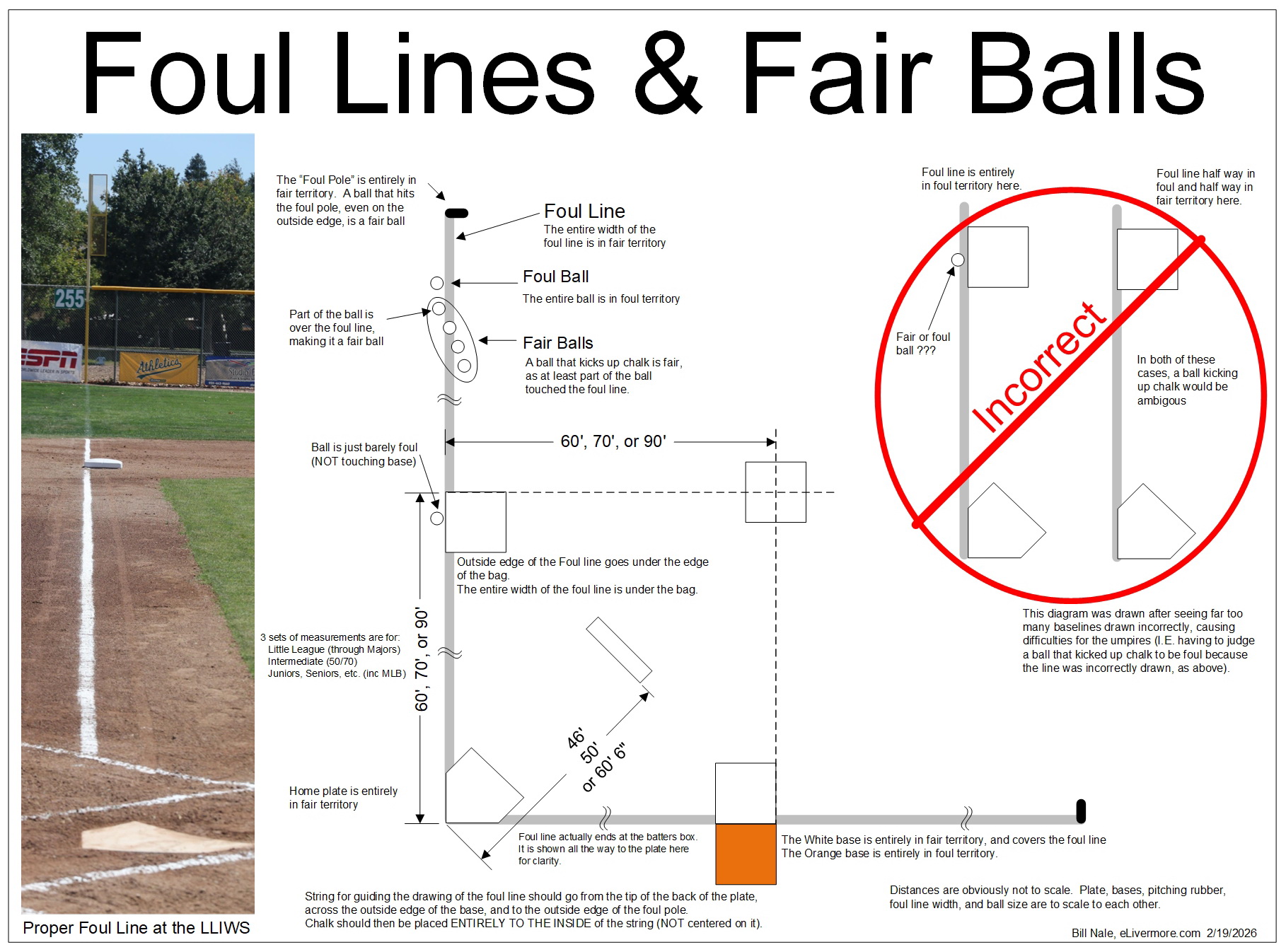
The following diagram was created
mainly to show how the foul lines should be drawn, after seeing them in the
wrong place too many times.
It also shows the definition of where measurements are taken for the bases and
the pitcher's mound, and the definition of fair and foul balls.
Most diagrams make the foul line a "line". I purposefully made the foul
"line" a thin rectangle, as that is what it really is. It has width.
That makes it clear that the outside edge is what is important, and where
everything is referenced from.
So in reality "foul line" is neither "foul" nor a "line"
A few years ago I posted it on the local league's Facebook page. It got shared to an umpire forum, and received hundreds of
comments.
Mostly about the location of second base. The drawing is correct, in that
2nd base is offset, with the 60, 70, or 90 feet measured to the CENTER of that
base. This is correct for all forms of baseball and softball, including MLB.
I did not need to make any changes to the diagram based on those comments.
I did update it in 2025 just before the LLIWS to include the double first base.
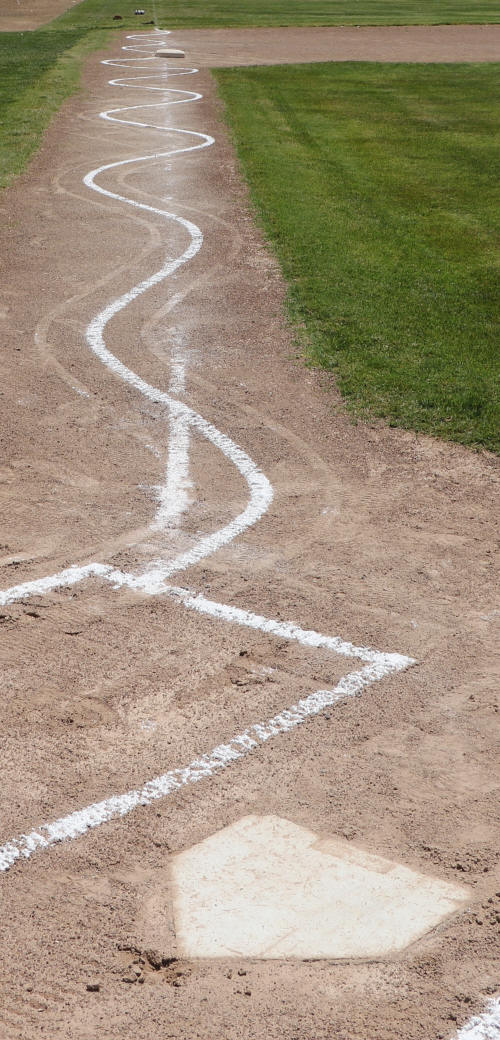
There is an excuse for this one.
It was our local "12 year old game" with goofy rules and about 30 players on the
field at a time.
As above, this is my opinion.
Consider it unofficial
There is a lot of confusion about the double first base.
It was introduced to Little League Tournament Play in 2025, with an announcement
8 days before the the LLIWS began.
See LL Press release here
There were some televised confusing incidents which occurred that year, but
interestingly they were mostly in Softball, where they have been using the
double first base for many years.
We had no issues here at the Intermediate World Series. See
here for a recap of
the double first base that year at the LLIWS.
One of the main confusing plays that was televised, and often
replayed, was at the Central Regional for Softball.
In that play, the batter-runner appeared to be called out because she touched
the orange base first when returning to the bag after being safe on the play.
This caused a lot of confusion and a lot of comments on social media.
As it turns out, the batter-runner was called out for missing the orange bag
when initially crossing first base and being tagged out before returning.
As simple as that.
Nothing about returning to the "wrong base". Nothing about turning to the
left instead of the right, etc.
My primary clarifications over and above the official rules has to do with the Touching Dirt concept, touching the orange base first upon return, and touching both bags at the same time.
Double First Base Basics
For the official rules, search for "Double" in the rule book app. It will
be about the 4th entry. It is 7.15.
The official wording leaves a lot to be desired.
Where it says: "On extra-base hits or other balls hit to the
outfield when there is no chance for a play to be made at the double first
base",
Replace with the words "When no play is being made at first base".
That is what other Little League material uses, and it covers all cases.
The official rules also do not cover the case when returning to the base of touching the
orange base first and continuing to the white portion. This is a major
source of misunderstanding.
My description:
The White base is in the same place as always: Completely
in fair territory and on top of (covering) the foul line.
The Orange (or green) base is entirely in foul territory.
Whenever a play is being made on the better-runner the defense must use the white
section of the double first base.
Using only the orange portion is the same as the defensive player
being off of the base. Touching both is OK as long as they are not
obstructing the runner.
Whenever a play is being made on the Batter-Runner they (they
batter-runner) must use
the Orange base for their first attempt to tag first base.
Using only the white portion of the base is the same as missing the
base. Touching both is OK. Missing the base (or stepping only on the
white base in this case) is an appeal play. The defense must tag the
batter-runner before they get back to the white base.
When no play is being made on the batter-runner, they may use
either portion of the base.
Note that on a possible extra base hit they will normally want to
hit the inside edge of the white portion to round the base, as they would if
there was only a white base.
Even when overrunning the base when no play is being made they can
hit either or both, but runners will generally be taught to hit the orange in
this case, as they do not always know if there is a play being made or not, and
it is simpler to explain to them that way.
When returning to the base after overrunning or oversliding, the
batter-runner must use the white portion of the base.
Touching the orange portion does not count as being on base, but
also does not count as having returned to the base yet if they touch the orange
first when returning. They have not returned to the base until they touch
the white portion.
So touching the orange first when returning is of no consequence,
but they must continue on and touch the white portion. Once the white base
is touched they must continue to be on the white base or they are off base.
On an uncaught 3rd strike (Majors and above) both the fielder and
the batter-runner may use either base.
This is because the throw may be coming from the foul side of the
first base foul line. If there was no double first base, the fielder would
normally take up a position touching the outside edge (over the foul line) of
the base and
mostly standing in foul territory to make the catch. With the double first
base, this would be blocking the orange bag and likely cause an obstruction
call. With this rule they can use the orange base, likely the outside
edge, and not be blocking the base.
If the throw is coming from the foul side of the base on an
uncaught 3rd strike, the batter-runner may run in fair territory (outside of the runner's lane)
and would not be called out for interference if the thrown ball hits them, unless they
interfered intentionally.
Definitions:
Batter-runner is the batter who has just hit
ball, is running to first on an uncaught 3rd strike, or going to first base for
any other reason (walk, etc.). The rule book uses this term.
A Play is being made on the batter-runner is when the
defense is attempting to retire the batter-runner at first base following a
batted ball or uncaught third strike.
This normally involves a fielder
throwing the ball to the first baseman, but could also be the first baseman
fielding the batted ball and running to step on the base or tag the runner.
If the ball is hit to an infielder
and they do not throw the ball to first, or attempt to tag it or the
batter-runner themselves, there
is no play being made.
On a walk or hit by pitch, no play is
being made on the batter-runner (hit by pitch is a dead ball anyway),
Touching Dirt concept.
As far as the first baseman (or any fielder) is concerned, stepping on only the
orange base is like stepping on dirt and being off of the base, EXCEPT:
Blocking the orange portion can cause an obstruction call
(blocking dirt normally would not).
On an uncaught 3rd strike the fielder may use either base.
As far as the batter-runner is concerned, stepping on only the white portion of
the base on the first touch is like stepping on dirt and missing the base,
EXCEPT:
When no play is being made at first base (in which case
either base can be used on the first touch).
On an uncaught 3rd strike, when either base can be used.
As far as the batter-runner is concerned, AFTER the first touch, the orange base
is like stepping on dirt, and is considered being off base (unless also touching
the white base).
When returning after overrunning, touching the orange base is
meaningless. It does not count as returning to the base yet and does not count
as being on base.
On all following plays, the orange base is just like dirt.
Returning after a pitch or a pickoff, being on base at the time of pitch (majors
and below for baseball, all divisions of softball), sacrifice flies, etc.
What is told to players:
For players, you want to keep it simple. Especially younger players, so:
Batter-Runner:
If you are going to run through the base, always hit the Orange
base.
Go back to the white base when returning.
The orange base no longer exists. Do NOT go and stand on the orange
portion thinking you are on the base. You are not!
If you know that no play is being made on you at first, and you are
rounding the base (looking to go to 2nd, or going to 2nd), go ahead and use the
white base. No need to touch the orange.
If you return to the base you must use the
white base or you are "off base".
On an uncaught third strike, you may use either base. Try to
use the base that the fielder is not using.
At any point, touching both bases is OK.
Fielder:
Always use the white base.
Exception: on an uncaught third strike, use either base.
Go to the orange if the ball will be coming from the foul side of 1st base to
avoid the ball hitting the runner. Do NOT obstruct the runner. You
need to give him/her a clear path to run through the base at full speed.
How the "Appeal" works
An Appeal of the batter-runner missing the orange base when a play had been
made on them is done by tagging them with the ball before they return to the
White bag. You cannot just step on the base and say you are appealing, you
must tag them.
This is the exact same way missing first base is appealed.
It is also the same mechanics for when a runner rounds first base
or makes a move to 2nd base and gets tagged when off base. Those cases are
not Appeal Plays, however, just tagging a runner off base.
In this case when the appeal is being made the fielder may block the white
portion of the base if they choose to make sure that they can successfully make
the tag before the batter-runner returns.
They MUST have possession of the ball to block the base or it is
obstruction. Blocking the base (with the ball) did occur in the famous
video mentioned above.
If the appeal is unsuccessful (the umpire determines that the batter-runner did
NOT miss the orange base) the fielder must allow them to return to the white
portion.
You cannot get a "didn't immediately return to the base" ruling by
blocking the base, with or without the ball.
During this entire process if the batter-runner touches the orange base it is of
no consequence. It is like touching dirt. If they return to the
white portion THEN touch only the orange base, they are off-base (standing on
dirt) and can be tagged.
Umpire mechanics
If the umpire sees that the batter-runner touches only the white bag when
running through while a play is being made on them:
The umpire will call "safe" or "out" depending on whether the
runner beats the throw (etc.) or not, EXACTLY the same thing that is done if
they do NOT miss the base.
If out, they are out.
If safe:
The umpire will not indicate that the
orange base was missed in any way. They should NOT inform anyone of this
or make any indication (as with all appeal plays).
If no appeal is made (runner not tagged
before returning to the white bag), the runner is safe. No appeal can be
made after the runner returns to the white portion.
If the fielder tags the runner before
they return to the white base, the umpire calls them out. They would
generally explain why at that point.
This is the exact same mechanics as for missing first base entirely (double
first base or not). Also the same mechanics as when the batter-runner
makes a move to 2nd, but that case is not an appeal play, just a "tagged while
off base" play.
Note that the first baseman will generally not know if the batter missed the
orange base as they are concentrating on catching the ball. They are often
informed by a teammate (commonly the 2nd baseman) or a coach from the bench.
Shouting: "Tag them".
As I have said before, this is UNOFFICIAL. It is my opinion. I have
extensively studied this, however.
|
|
Case |
Result |
|
1 |
Batter-runner hits the orange portion of the base when running through. First baseman uses white portion of the base to make the play. Batter-runner is safe at first (beating the throw), and overruns the bag, then returns to the white portion. |
Batter Safe. Everyone did exactly the right thing. |
|
2 |
The batter-runner is out at first, as the throw beats the batter-runner to the base with the first baseman's foot on the white base. |
Just a normal "force out" (see Note 2) at first regardless of which base the batter-runner hits. Umpire calls out, as they would do with no double first base. The batter-runner hitting the wrong base is of no consequence as they are already out. See #15 below. |
|
3 |
Batter runner hits only the white portion of the base when running through when a play is being made at first base. He/she is tagged before returning to the white portion. |
Batter-runner is out. A play must have been being made at the time of the initial touch. I.E. the ball thrown to the first baseman or if the first-baseman fielded the batted ball, they attempt to tag the base or the batter-runner. This is the same as missing first base. Returning to the orange base does not qualify as returning, and is the same thing as stepping on dirt. The umpire will initially call him/her safe, as it is an appeal play. When the tag is made they will call the out. This is by far the most common "double first base" out (not counting the standard "force" out (See Note 2). |
|
4 |
Same as above, but batter-runner returns to the white portion before being tagged. |
Safe. They must be tagged before returning to the white portion. Touching the orange portion in the process of returning is meaningless. |
|
5 |
Same as #1, but batter-runner, when returning to the base steps on the orange base first and continues onto the white portion. He/she is tagged between touching the orange base and touching the white base. After then touching the white base he/she remains on the white base. |
Batter-runner is Safe. Stepping on the orange bag first is of no consequence. It does NOT count as being on base, but it also does NOT count as having returned to first base yet. It is like the orange base is not there and the batter-runner just touches dirt. Stepping on dirt before returning to the white base and being tagged is not an out. The batter-runner pretty much HAS to step on dirt in the process of returning. |
|
6 |
Same as #5, except after touching the orange, then returning to the white bag, the batter-runner is standing only on the orange portion and is tagged. |
Batter-runner is out. This is returning to the base (when stepping on the white portion) then stepping back off of the base. They can be tagged out. |
|
7 |
Same as #1, but batter-runner, when returning to the base steps on the orange base first but lingers there for a while. |
This becomes umpire judgment. There is a rule that the batter-runner must return immediately to the base after overrunning or oversliding (7.10 (c)). So this is the same as the batter-runner properly overrunning, then coming back and standing on dirt near the base. If they linger very long and are not physically impeded from getting to the white portion of the base, they are in jeopardy of being tagged out. How long they have to linger before being in jeopardy may vary from umpire to umpire. Probably more than several seconds of lingering there. The reason for the double first base is safety, not to find new ways to get someone out. |
|
8 |
Same as #1, but batter-runner's foot touches both the white and orange portion of the base when running through. |
Safe. Touching the white portion at the same time as the orange portion is of no consequence. It is the same as touching the orange portion and dirt at the same time. |
|
9 |
Batter-runner hits only the white portion of the base when running through when no play is being made on them. |
If no play is being made on the runner they may use either the white or orange base for their first touch. This could be a ball hit to the outfield (and no play being able to be made), ball hit to the infield but not thrown to first (fielder's choice, etc), error on infielder resulting in no throw to first, or a walk/hit by pitch. If they over-run the base and are tagged before properly returning, they are safe. |
|
10 |
Batter-runner hits only the white portion of the base when running through on a ball hit to the right fielder. The right fielder throws the ball to first in an attempt to get the batter-runner out before they reach first base. The batter-runner beats the throw, but is tagged before returning. |
Batter-runner is out. Even
though the ball went to the outfield, the right fielder was attempting to
make the play at first, so this counts as a play being made on the
batter-runner. |
|
11 |
Batter-runner hits the orange portion of the base when running through. First baseman touches only the orange portion of the base and the throw beats the runner. |
Runner is safe. The first baseman must be touching the white portion. This is the first baseman missing the bag. The exception is on an uncaught 3rd strike. |
|
12 |
Batter-runner hits the orange portion of the base when running through. First baseman touches both the white and orange portion of the base and the throw beats the runner. |
Batter-runner is out, unless the fielder obstructs the runner. Example of obstruction: Fielder has one foot on the white base, the other foot fully on the orange base and is blocking the ability of the batter-runner to run through the base without slowing down, or unduly veering off. |
|
13 |
Uncaught third strike. |
The batter-runner and the fielder may use either portion of the base (batter-runner on the first touch only - must return to white to be on base). If the throw is coming from the foul side of of the base, the runner can run in fair territory (out of the normal Running Lane) and would not be called for interference if the thrown ball hits him/her, unless they intentionally interfere. This is interesting, in that the batter-runner would often not know where the ball was thrown from. |
|
14 |
Batter-runner sliding head or feet first into only the white portion, maintaining contact, and being tagged. A play was being made at first base. |
Hmmm. A bit tricky. First touch was on the wrong bag, but they have already "returned" to the white bag??? It is not actually an overrun or overslide case, however, so they may not be able to leave the base without jeopardy of being tagged. I have seen this happen in the LLIWS, but the batter-runner was already out as the throw beat him to the base. |
| 15 |
The batter-runner is called out at first, as the throw beats the batter-runner to the base with the first baseman's foot on the white base. Batter-runner hits only the white base. First baseman tags him/her. Video review (World Series, etc.) determines that the first baseman had their foot off of the bag on the initial play. |
Now I'm getting a bit obscure,
but it can happen. I would assume here that the batter-runner would be
out for missing the bag and being tagged. |
| 16 |
Bunt or ball hit that goes about 10 to 20 feet down the first base line. Pitcher runs over, picking up the fair ball as it sits on the 1st base line with his momentum taking him well into foul territory as he makes the throw to first base. First baseman goes to the outside portion of the orange bag (not touching the white bag) to take the throw from foul territory, and the throw beats the runner. |
Safe. 1st Baseman is not on the bag. The fielder can ONLY use the orange base on an uncaught 3rd strike. |
Note 1: If the batter-runner makes a move toward 2nd base after overrunning or oversliding the base, they are in jeopardy of being tagged out in any of the situations above and must get back to the white portion, or continue on to 2nd base to avoid being tagged out. If they had also missed the orange portion of the bag when a play was being made on them and continued to 2nd base, they have missed first base and could be out on appeal.
Note 2: Technically there is not a Force Out at first base, but the same rules apply as for a force out.